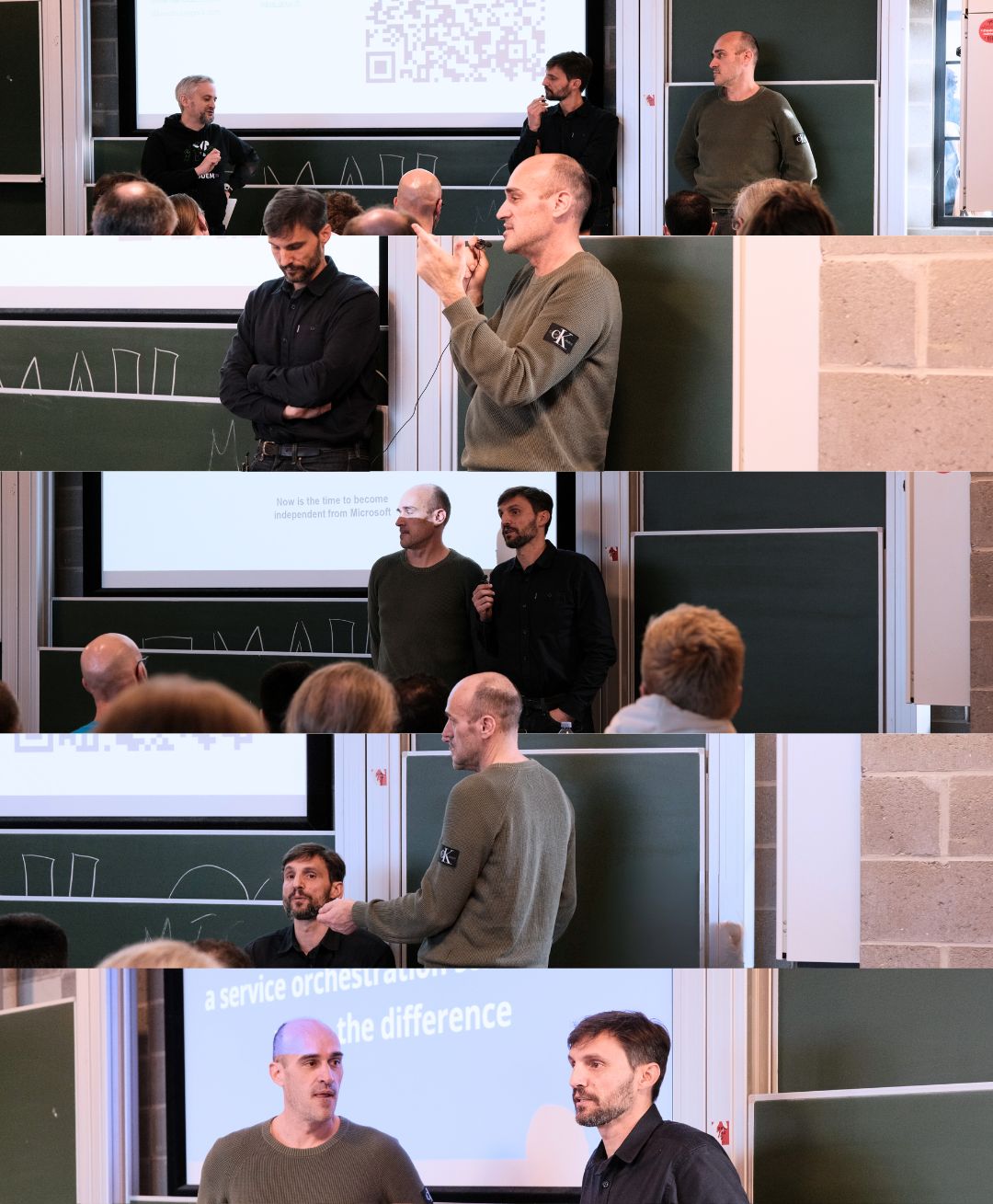
On February 1-2, 2025, Benjamin Andre, Twake strategic director at LINAGORA, and Samuel Paccoud from DINUM (the French Interministerial Digital Directorate) took the stage at FOSDEM 2025 in Brussels to address one of the most pressing questions in European digital sovereignty: why does Europe remain dependent on Microsoft 365 despite having quality open source collaborative solutions?

The Structural Barrier
The talk challenged a widespread assumption. Europe has no shortage of excellent open source tools: email, document collaboration, project management, video conferencing. Individually, these solutions often match or exceed the functionality of their proprietary counterparts. So why hasn't a credible alternative emerged?
The barrier is structural, not technical. Individual apps are not the problem. The absence of an orchestration layer is.
Microsoft 365 doesn't win because Word is better than LibreOffice or because Teams is better than any single open source video tool. It wins because everything is connected: identity, navigation, data, and workflows flow seamlessly across applications. Open source tools, despite their quality, remain isolated islands.
AI Changes the Game
The speakers highlighted a critical inflection point: artificial intelligence is rapidly closing the functional gap between open source and proprietary solutions. Features that once took years to develop can now be integrated in months. The technical differentiator is shrinking fast.
But AI alone doesn't solve the orchestration problem. An AI assistant that only understands one app's context is far less useful than one that can reason across your entire workspace. This makes the case for an orchestration standard even more urgent.
Introducing Open Buro
This is where Open Buro was introduced to the FOSDEM audience: an open orchestration standard enabling independent open source services to integrate into a fluid, interoperable work environment—without creating new proprietary silos.
The Open Buro Approach
Rather than building yet another suite, Open Buro provides the missing orchestration layer: a shared standard for identity, navigation, data exchange, and AI integration. Publishers keep their independence. Users get a unified experience.
The presentation drew a clear line between two approaches:
- The suite approach: build everything from scratch under one vendor (creates new lock-in)
- The standard approach: define interoperability protocols that let existing apps work together (preserves freedom)
Open Buro takes the second path, inspired by how the web itself works: shared standards, independent implementations, collective benefit.
Making Workspaces Work Together
The presentation was part of the "Open Source In The European Legislative Landscape and Beyond" track, alongside a complementary talk by Samuel Paccoud and Alexander Smolianitski (ZenDiS) titled "Making Workspaces Work Together (And Across Borders)". This session explored how France's La Suite numerique and Germany's openDesk are pioneering cross-border collaboration between sovereign digital workspace initiatives.
The Question That Remains
The presentation concluded with a challenge to the audience—one that remains at the heart of the Open Buro project:
Where do you see the real obstacle to building a credible European alternative to Microsoft 365?
The response at FOSDEM was clear: the open source community is ready for orchestration. What was missing was a standard and a coalition to build it. Open Buro intends to be both.
Back to all news